Guide · Learn Kitesurfing
How to Waterstart in Kitesurfing: Why Beginners Struggle
Short answer
The waterstart is the hardest step for many kitesurfing beginners because several things must happen almost at once: the right board angle, pressure through heels and toes, a balanced body position, a well-timed kite movement in the wind window, power control on the bar and correct kite steering once you start moving. Instructors usually correct one element at a time, and falling is a normal part of the process.
Why the waterstart is the hardest step
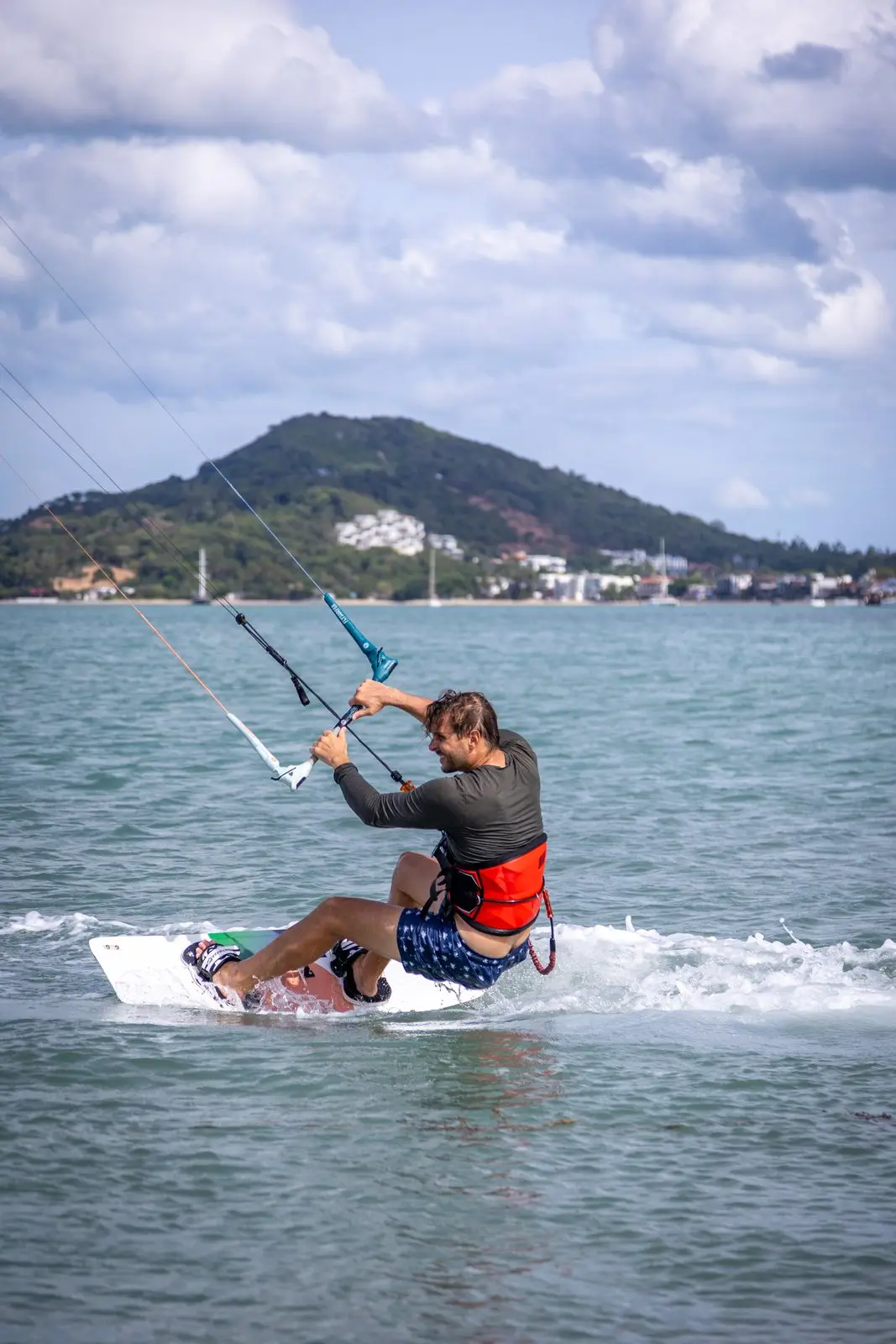
Up to this point, most skills can be practised one at a time. You learn to steer the kite, then to control its power, then to let it pull you through the water. The waterstart is different. It asks you to combine several movements in a few seconds, while lying in the water with a board on your feet and a kite above you.
That is why students who have controlled the kite well for hours can suddenly feel they are starting from scratch. They are not. Each element is already there. What is missing is the coordination between them, and that only comes with practice.
What has to come together
The list below explains what your instructor is looking at. It is not a sequence to try on your own.
Board position and angle
The board has to point in a direction that lets the kite pull you up and across the wind, not straight downwind. A board at the wrong angle either sinks or shoots away.
Heels and toes
How you press through your heels and toes decides whether the board edges against the pull or slides away under you.
Body position
Where your weight is, how bent your legs are and where you look all affect whether you come up over the board or get pulled off it.
Balance
The moment you come out of the water, you have to find your balance on a moving board while the pull changes.
Kite movement in the wind window
The kite needs to move through the right part of the wind window at the right moment to generate the pull you need. Too little and nothing happens; too much or in the wrong direction and you are lifted or dragged.
Power and pressure on the bar
How you use the bar controls how much power the kite delivers. Beginners often pull in too much or let go at the wrong moment.
Steering after you start moving
Getting up is only half of it. Once the board starts to move, the kite has to be steered correctly so that the pull continues and you keep riding instead of stopping or falling.
Waterstarts in lighter wind
Koh Samui is generally a moderate or lighter-wind destination. In lighter wind the kite has to be moved more actively to generate enough power, so the steering technique becomes more demanding. A suitable kite size helps, which is one reason why larger kites are common here. Our kite size guide explains more.
How instructors build the waterstart
Trying to fix everything at once rarely works. During lessons, an instructor usually corrects one element at a time: first the board position, then the kite movement, then the body position, and so on. Each attempt adds a little to your coordination and muscle memory.
Why one thing at a time? When you think about six things at once, none of them gets your full attention. Fixing one element and repeating it lets your body learn it, so it no longer needs your attention on the next attempt.
Falling is part of it
You will fall into the water many times. That is normal and expected, and every fall tells your instructor something useful. Then, usually quite suddenly, the movements start to work together, and the waterstart begins to feel much more natural.
When do students start trying?
The right moment depends on your kite control, your skills and the conditions on the water. Before your first waterstart attempts, you need to be comfortable with safety, kite control in the water, body dragging and self-rescue, and your instructor decides with you when you are ready. Our recommended first course is 6 hours, which gives you time to work on these foundations, as explained in our beginner’s guide. Fitness, confidence and board-sport experience also play a role, and nobody can promise a first ride after a set number of hours.
This guide is based on what Mahalo has seen while teaching on Koh Samui since 2018. The owner has more than 10 years of experience in water sports.
FAQ
Why can’t I get up on the board?
Usually because several movements are not yet working together: the board angle, the pressure on heels and toes, body position, and the timing and direction of the kite movement. Instructors work on one of these at a time until the coordination comes.
When do beginners start trying water starts?
It depends on how well you control the kite, your own skills and the conditions on the water. Some students are ready sooner, others need more time on kite control and body dragging first.
Is it harder to waterstart in light wind?
It can be. In lighter wind the kite movement has to generate more of the power, so steering technique and timing become more demanding.
Can I learn the waterstart from videos?
Videos can help you understand the idea, but the waterstart depends on reacting to the kite and the wind in real time. Practise it with an instructor who can see what is happening and correct one thing at a time.