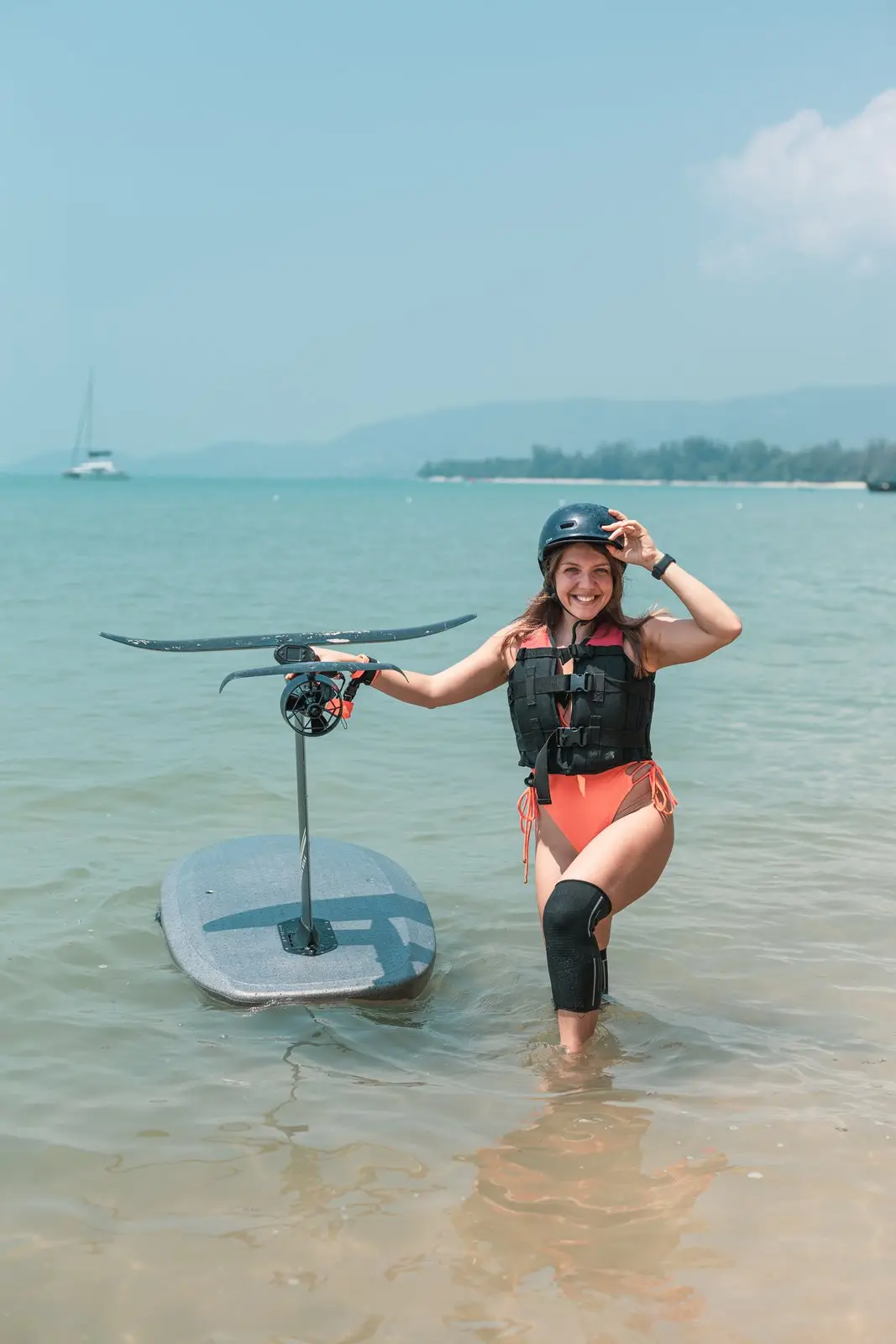
Guide · E-Foil
E-Foil vs Wingfoil: What's the Difference?
Short answer
Both sports ride a board on a hydrofoil, but the power is different. An e-foil has an electric motor and a hand-held remote, so it needs no wind and works best on calm water. In wingfoiling you power the board with a wing in your hands, so you need suitable wind and must learn wing control as well as balance on the foil. E-foiling is usually quicker to start; wingfoiling is a wind sport you can take anywhere there is wind.
The main difference: motor or wind
From a distance an e-foil and a wingfoil look similar: a rider gliding above the water on a small board. The difference is where the power comes from. An e-foil has a quiet electric motor on the mast. A wingfoil is pushed by the wind, caught in a wing the rider holds in both hands.
Comparison table
| E-foil | Wingfoil | |
|---|---|---|
| Power | Electric motor, speed on a remote | Wind, caught in a hand-held wing |
| Conditions | No wind needed; calm, sheltered water is best | Suitable wind and enough water depth |
| First steps | Lying, kneeling, then standing on the board | Wing control on a large, stable board |
| Main challenge | Balance and flying smoothly | Wing control plus balance on the foil |
| Weight limit | Maximum rider weight 100 kg | Equipment chosen for your weight |
Conditions you need
An e-foil needs calm, sheltered water of suitable depth, free of reefs and obstacles. Wind is not needed and choppy water makes it harder. A wingfoil needs steady, moderate wind, and the foil needs enough depth. On Koh Samui, wingfoil lessons follow the kitesurfing seasons at Nahai Beach and Nathon, while e-foil sessions are planned around calm water.
Balance on the hydrofoil
Both sports teach you the same basic feeling: a board that rises above the water and reacts to small shifts in your weight. On an e-foil you can focus on that feeling, because your hands only hold a remote. On a wingfoil you have to manage the wing at the same time, which is why we teach wingfoil beginners on a stable board before the foil.
Handling the equipment
An e-foil is a complete powered system: board, hydrofoil, motor, battery and remote. It is expensive equipment, and it is set up and checked by Mahalo. A wingfoil set is lighter and simpler: a wing, a foilboard and a hydrofoil. Riders learn to set up and carry their own wing as part of lessons.
How hard is each one?
E-foiling is often easier to start than people expect, because they do not have to create the power themselves. Standing up and flying smoothly still takes practice, and it can be physically demanding at first. Wingfoiling takes longer to learn because you master two things: the wing and the foil. Progress in both is individual.
Who each sport suits
- E-foil: guests who want to try foiling without learning a wind sport, and anyone who wants a session on a calm day.
- Wingfoil: people who want a wind sport they can keep learning and practise wherever there is wind.
- Both: riders who want to get used to the foil on an e-foil and learn wing skills on windy days.
An option for calm days
Wind is never guaranteed. On calm days when there is no suitable wind for wingfoil or kitesurfing, an e-foil session is a way to stay on the water. Read the e-foil beginner’s guide or the wingfoil beginner’s guide to learn more about each.
FAQ
Is e-foiling easier than wingfoiling?
For many beginners the start is easier, because the motor provides the power and you begin lying down. Standing up and flying smoothly still takes practice. Wingfoiling adds the challenge of controlling a wing and depends on the wind.
Does e-foiling help with learning wingfoiling?
It can help you get used to the feeling of a board on a hydrofoil, such as how weight shifts change the height. Wing control and riding with the wind still have to be learned separately.
Can I do both on the same trip?
Yes. You can use calm days for e-foiling and windy days for wingfoil or kitesurfing lessons.